

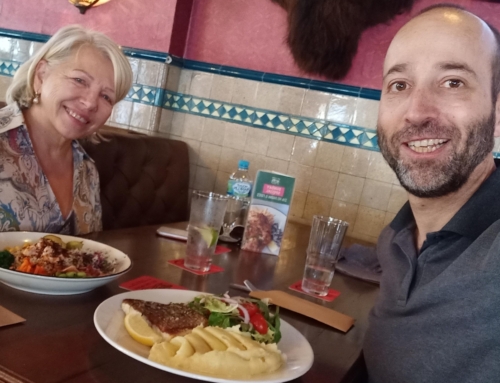
Ian Hoskins, the 453rd person I’ve met on my quest to have lunch with 500 strangers, is an award-winning historian who has advanced our understanding of Sydney, New South Wales and Australia.
In his first book, ‘Sydney Harbour: A History’, Ian told the story of one of the world’s great harbours. That later inspired him to write ‘Coast’, which was the first written account of the New South Wales coast. Ian has also written ‘Rivers’, which explores 10 of Australia’s most important rivers, and ‘Australia & the Pacific’, which covers our ties with the region.
Ian has loved history since he was a child – he even told a family friend he would become an historian without having any idea what that entailed. While not a brilliant school student, that interest led to the completion of a BA Hons at Sydney University – majoring in history. The pathway to Ian’s desired career academia was not immediately clear so he studied archiving, which taught him a valuable lesson – he didn’t want to spend his life collecting and organising records.
One day, Ian received a phone call from Associate Professor Neville Meaney, a prominent historian who had been one of his lecturers. To his surprise, the great man was calling to offer him a job teaching American history. Ian never found out why Prof. Meaney chose him out of all his students – he was too intimidated to ask – but suspects it was because of his writing skills.
The offer from Prof. Meaney was a turning point in Ian’s life as it gave him a pathway to complete a PhD. Choosing a dramatically different area to study was another turning point. His choice of the social and cultural history of the landscape of Sydney in the late 19th and early 20th centuries provided knowledge which formed the foundation of Ian’s career: in addition to writing his books, he’s served as a curator at the Powerhouse Museum and, for the past 22 years, as the North Sydney Council’s historian. He’s currently researching and writing a history of North Sydney.
As Ian lamented, many Sydney homes and buildings were torn down after World War 2, because New South Wales didn’t introduce its Heritage Act until 1977 – and, presumably, because we didn’t properly understand our history. Ian is playing an important role in filling that knowledge gap.









Leave A Comment